About the International Space Station
The International Space Station (ISS) mission is to serve as a unique microgravity laboratory for scientific research, enabling long-term human space exploration and providing benefits to Earth. ISS is humanity's most expensive object and has been in orbit for 25 years.
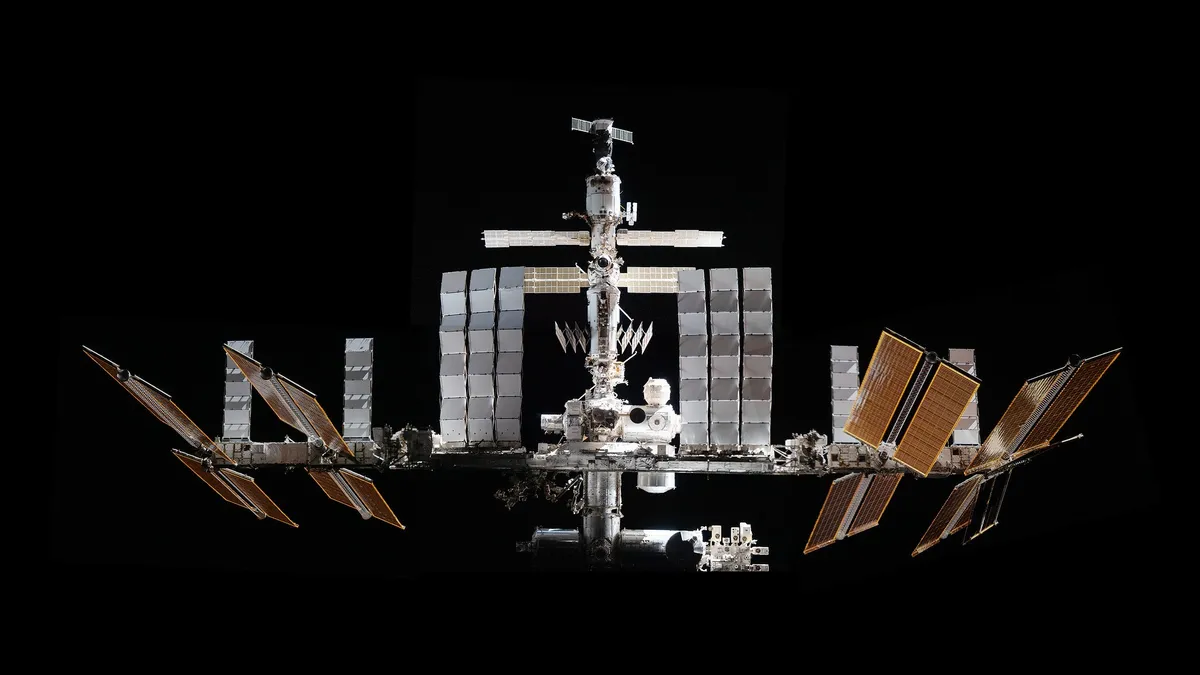 The International Space Station
Orbiting some 400km (250 miles) above the Earth, the ISS represents one of mankind's most ambitious engineering projects. Since the first Expedition 1 mission, more than 280 astronauts and cosmonauts have visited the ISS, and it has now been continuously occupied for 25 years. If you were born after 2 November 2000, for your entire life, there has always been someone living in space.
As of May 2022, 258 individuals from 20 countries have visited the International Space Station. The top participating countries include the United States (158 people) and Russia (54 people). Astronaut time and research time on the space station are allocated to space agencies according to how much money or resources (such as modules or robotics) they contribute. The ISS includes contributions from 15 nations. NASA (United States), Roscosmos (Russia) and the European Space Agency are the major partners of the space station and contribute most of the funding; the other partners are the Japanese Aerospace Exploration Agency and the Canadian Space Agency. Through a private company called Axiom Space, private astronauts are starting to work on the orbiting complex, from time to time; additionally, astronauts from other nations such as the United Arab Emirates do fly occasionally to the ISS.
Current plans call for the space station to be operated through at least 2024, with the partners discussing a possible extension. NASA has approved an extension to 2030, although Russia says it will withdraw after 2024 to focus on building its own space station around 2028. How the station will be operated after Russia's departure has not yet been determined. After 2030, plans for the International Space Station are not clearly laid out either. It could be deorbited, or recycled for future commercial space stations in orbit.
Crews aboard the ISS are assisted by mission control centers in Houston and Moscow and a payload control center in Huntsville, Ala. Other international mission control centers support the space station from Japan, Canada and Europe. Elements of the ISS are controlled by mission control centers in Houston or Moscow.